In Brief
Rubber piston replacement — most wearable component of a concrete pump: 200,000+ cycles per operating year against abrasive concrete. Replace when clearance (cylinder bore − piston diameter) exceeds 0.5 mm (low-pressure systems up to 80 bar) or 0.3 mm (high-pressure above 120 bar). Warning signs: cement slurry in water chamber, pulsating concrete delivery, increased power consumption. Neglecting replacement leads to cylinder damage, then concrete in hydraulic oil, then destroyed main hydraulic pump. Regular replacement is always cheaper than breakdown repair. Quotation on request — +48 602 716 551.
When to replace rubber pistons in a concrete pump
Rubber pistons are the most wearable component of a concrete pump. A single pump performs 200,000+ cycles per year of operation. With abrasive concrete, this adds up fast. Yet many operators delay replacement until the symptoms become impossible to ignore — at which point the repair bill is far higher than a timely piston swap would have been.
Symptoms of worn rubber pistons
- Cement slurry in water chamber – visible white milky liquid after pumping and opening the water relief valve
- Irregular concrete delivery – pulsating instead of smooth flow at the pipe end
- Increased power consumption – hydraulics working harder to compensate for lost sealing
- Visible mechanical damage – chips, torn edges, deformation visible on removed pistons
- Loss of output pressure – pump operates but does not reach rated delivery volume
How to measure piston wear
Measure external diameter of the piston, measure internal bore diameter of the cylinder. Clearance = cylinder bore – piston diameter
Replacement threshold:
- Low-pressure systems (up to 80 bar): clearance >0.5 mm
- High-pressure systems (>120 bar): clearance >0.3 mm
Measurement requires a micrometer and bore gauge; do not estimate by feel. If you are unsure, our technician can measure on-site or in the workshop.
Piston replacement intervals by brand
| Brand | Typical interval | Notes |
|---|---|---|
| Putzmeister | Every 25,000–35,000 m³ | High-pressure BSF models: check every 15,000 m³ |
| Cifa | Inspect every 3,000 m³, replace at tolerance | SCC and TR0 concrete: shorten interval |
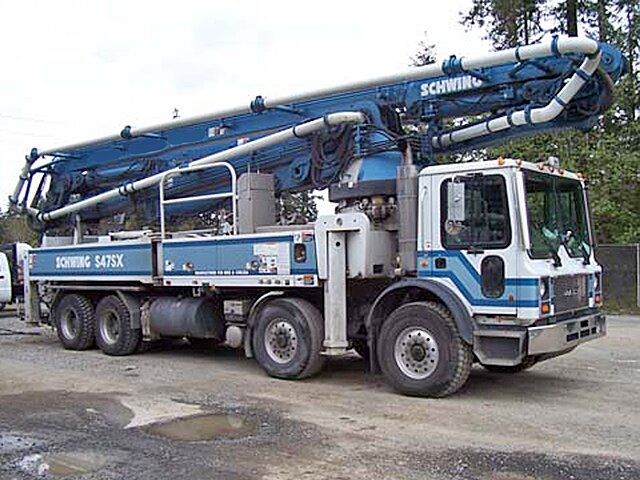
| Schwing | Every 20,000–30,000 m³ | Rock valve models: valve wear often precedes piston wear |
| Generic/rebuilt pumps | Every 10,000–15,000 m³ | Piston quality varies; measure regularly |
These are guidelines only. Actual wear depends on concrete abrasiveness (aggregate size and hardness), pump pressure and working hours. Hard aggregate and high-pressure output accelerate wear significantly.
The wear cascade — why timely replacement matters
Worn pistons do not simply reduce efficiency. They trigger a cascade of increasingly expensive damage:
Stage 1 – Worn pistons: delivery pressure drops, concrete is pulsating. Pump still works.
Stage 2 – Cylinder scoring: cement particles slip past the worn piston and abrade the steel cylinder bore. Once the cylinder is scored, piston replacement alone is not enough — the cylinder needs honing or replacement. Cost: several times the piston job.
Stage 3 – Concrete in hydraulic oil: if the water buffer in the water box runs dry (common when operators top up infrequently), cement slurry reaches the hydraulic side. The hydraulic oil turns grey, viscosity drops, and hydraulic pumps and valves are contaminated.
Stage 4 – Hydraulic system rebuild: the main hydraulic pump and control valve block must be replaced. This is the most expensive repair in the pump’s service life — typically ten times or more the cost of a scheduled piston replacement. A full hydraulic flush and filter replacement adds to the bill.
Replacement cost vs cost of neglect
We quote each job individually after inspection — but the proportions hold across brands:
| Scenario | Relative cost |
|---|---|
| Scheduled piston replacement | baseline — the cheapest scenario |
| Worn pistons → damaged cylinders | several times the piston job |
| Concrete in oil → destroyed hydraulic pump | ten times and more |
| Construction site downtime | ongoing daily losses on top of the repair |
How we carry out piston replacement
At PHS Magnum in Chorula, piston replacement follows a fixed protocol:
- Visual and measurement inspection – pistons removed, diameter measured, cylinder bore checked
- Water box inspection – cement contamination and water buffer level assessed
- Hydraulic oil sample – we check for grey discolouration indicating concrete ingress
- Piston replacement – OEM or quality-matched replacement pistons, correct lubricant applied
- Pressure test – pump run at rated pressure, delivery volume and pulsation checked
- Cylinder honing (if required) – restores bore tolerance when scoring is found
We carry replacement pistons for Putzmeister, Cifa and Schwing from stock. Other brands: typically 1–3 working days for parts.
Need piston replacement or pump diagnostics? Call +48 602 716 551 – we respond within 2 business hours.
Related: Pump maintenance · S-valve and cylinder regeneration · TDT inspection for concrete pumps