In Brief
Boom pump: maximum mobility and arm reach up to 63 m — ideal for multi-storey and high-rise construction. Trailer/line pump: lower purchase cost, highly flexible pipeline routing — suits foundations, industrial floors and slabs. Mixer pump: transport and pumping in a single vehicle — the best choice for dispersed, low-volume jobs. Key selection criteria: reach, output, concrete mix, site access, and return on investment vs rental. PHS Magnum services all three types across the Putzmeister, Cifa, Schwing, Mecbo and Sermac brands.
Three Types of Concrete Pump — What Sets Them Apart?
The concrete pump market is divided into three main equipment categories. Each has its optimal application, defined limitations and specific servicing requirements. Mismatching equipment to a site generates costs — either by paying for unnecessary capacity or through downtime caused by insufficient reach.
Boom Pump (Self-Propelled)
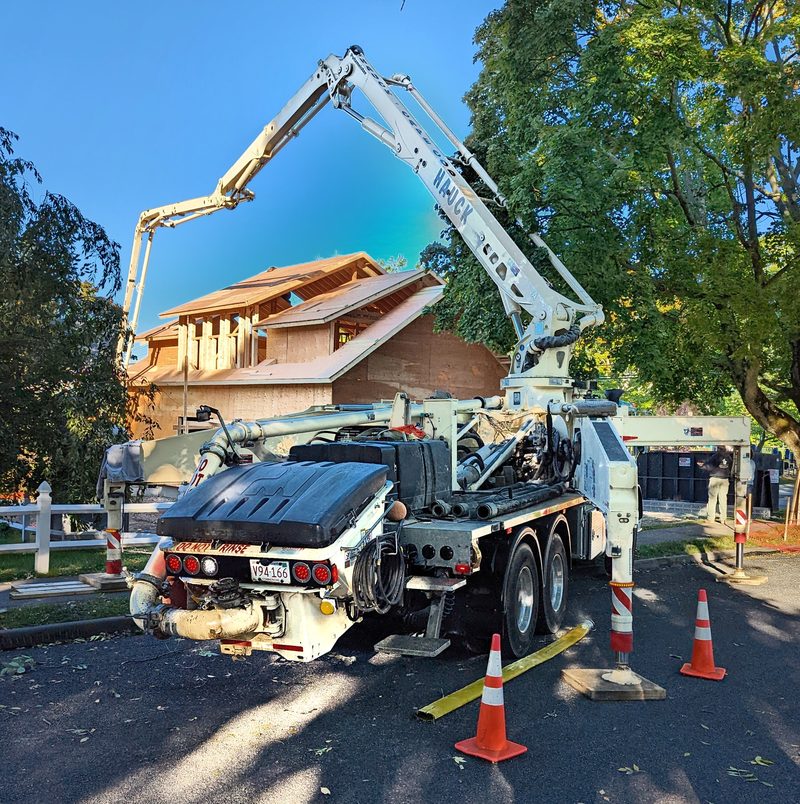
A boom pump is a self-propelled machine with a hydraulically operated multi-section boom. Concrete is fed directly from the mixer truck into the pump’s hopper, then forced through the pipeline built into the boom to the distribution end-hose.
Advantages:
- Boom reach from 24 to 63+ metres, both horizontally and vertically
- Fast deployment — the machine is ready to work 15–20 minutes after arrival
- Single operator runs the entire unit
- High output: 60–160 m³/h depending on the model
Disadvantages:
- High purchase and running costs
- Requires adequate ground-bearing capacity under the outriggers (outriggers can exert considerable pressure)
- Large dimensions make access to tight plots difficult
Typical applications: Multi-storey residential buildings (4–16 floors), offices, bridges, industrial structures with large monolithic reinforced-concrete elements.
Trailer Pump (Line Pump)
A trailer pump is a stationary or trailer-mounted unit that pumps concrete through sections of DN 100–125 pipeline laid manually along the pour route.
Advantages:
- Significantly lower purchase cost than a boom pump
- Concrete can be routed through narrow passages, stairwells, and horizontal or vertical runs of any geometry
- Lower ground-bearing requirements — the pump itself is lightweight
- Lower operating and servicing costs
Disadvantages:
- Pipeline laying time (20–60 minutes depending on route length)
- Requires several operatives to handle and strip down the pipeline
- Reach depends on pipeline length and pump pressure (typically up to 300–500 m horizontally)
Typical applications: Single-family house foundations, floor slab pours, industrial floors, tunnels, structures with limited overhead access, large-area horizontal pours.
Mixer Pump (Transit Mixer Pump)
A mixer pump combines a concrete mixer and a pump in a single vehicle. Concrete is either mixed on-site from dry materials or transported ready-mixed, then pumped through a short boom or pipeline.
Advantages:
- Transport and pumping in one vehicle — no need to arrange a separate mixer truck
- Ideal for dispersed jobs (a foundation, a driveway, a small slab)
- Reduced waiting time for concrete delivery
- Optimal for small volumes (2–15 m³ per job)
Disadvantages:
- Limited pumping output (30–60 m³/h)
- Shorter boom reach than dedicated boom pumps (typically up to 12–16 m)
- More complex logistics — one vehicle fulfils two functions
Typical applications: Minor concrete works, detached house foundations, driveways, yards, and small volumes spread across multiple locations.
Concrete Pump Selection Criteria
1. Pour Reach
The key question: how far must the concrete travel from where the machine is positioned?
- More than 15 m vertically or 50 m horizontally → boom pump or trailer pump with a long pipeline run
- Access from one side of the building only, upper floors → boom pump with a long boom
- Small areas, close access → trailer pump or mixer pump
2. Output (m³/h)
Divide the planned daily volume by the available pouring window. For a 200 m³ slab over 6 hours, you need at least 35 m³/h net. Add a 20–30% technological margin.
3. Concrete Mix
Self-compacting concrete (SCC) and TR0 mixes are more abrasive and require pumps with higher delivery pressure. Mixes containing aggregate larger than 32 mm may cause problems for smaller trailer pumps.
4. Site Access
Check: ground-bearing capacity (especially for boom pumps), access-road width, distance from the building face, and space for outrigger deployment.
5. Return on Investment vs Rental
| Parameter | Rental | Own Equipment |
|---|---|---|
| Working days per year | up to 15–20 | more than 20 |
| Unit cost | higher per day | amortises over time |
| Servicing | landlord’s responsibility | owner’s responsibility |
| TDT inspection | landlord’s responsibility | owner’s registration and inspections |
When to Rent, When to Buy?
Rent when:
- You are starting out and uncertain about order volumes
- You have a one-off large contract requiring specialist equipment
- You want to avoid servicing, insurance and TDT inspection costs
Buy when:
- You have a steady client base and a predictable schedule
- The equipment will be working more than 20 working days per year
- You want to build in-house servicing expertise and reduce dependence on third-party suppliers
What Does PHS Magnum Service?
PHS Magnum in Chorula near Opole specialises in the servicing and repair of all three types of concrete pump — boom pumps, trailer pumps and mixer pumps. Brands covered include Putzmeister, Cifa, Schwing, Mecbo and Sermac.
Services offered:
- Pumping-system overhaul (pistons, S-valves, cylinders)
- Hydraulic system diagnostics and repair
- TDT inspections — mandatory for legal operation
- Parts replacement: rubber pistons, S-valves, rock valves, DN hoses
- Mobile service within 200 km of Chorula — we come to your site or depot
ISO 9001:2015 certification underpins the quality of every job we carry out.
Need a service or advice on choosing the right equipment? Call: +48 602 716 551 (response within 2 hours).
Related: Concrete pump types · Pump servicing · TDT inspections · Spare parts