Summary
Schwing uses an open hydraulic circuit with a directional control valve – simpler in architecture than Putzmeister’s closed hydrostatic system, but requiring precise pressure diagnostics when faults occur. Most common failures: hydraulic control valve fault, main pump leakage, oil overheating. The BP 600 suits medium-scale construction; the BP 1400 is the machine for high-pressure, high-volume projects. PHS Magnum – mobile Schwing service within 200 km, tel. +48 602 716 551.
Schwing Hydraulic System: How It Works
To diagnose Schwing faults accurately, you need to understand the hydraulic architecture. What sets Schwing apart from Putzmeister or Cifa is primarily the control philosophy.
Open Hydraulic Circuit
Schwing trailer pumps and a significant portion of their boom pump range use an open hydraulic circuit. In practical terms:
- Hydraulic oil flows from the reservoir through the hydraulic pump to a directional control valve, then to the actuators (cylinders or hydraulic motors) and back to the reservoir
- Working pressure is generated on demand by a piston or gear pump
- S-valve switching is controlled by a separate hydraulic sub-circuit (typically pilot-operated or electrohydraulic)
The advantage of an open circuit is diagnostic transparency: pressure can be measured at defined test points throughout the circuit, and a pressure drop immediately indicates which branch has the fault.
Closed Hydraulic Circuit (Putzmeister) – the Contrast
For context: Putzmeister BSF boom pumps use a closed hydrostatic circuit (HSP – Hydrostatic Servo Pump). Oil circulates in a closed loop between the pump and the hydraulic motor without returning to the tank during operation. This is more energy-efficient and gives finer flow control, but requires higher oil cleanliness standards and is more expensive to repair – HSP overhaul is specialist work.
Variable-Displacement Hydraulic Pumps
Newer Schwing machines are fitted with variable-displacement hydraulic pumps controlled by a frequency converter or a load-sensing hydraulic servo. The system matches pump displacement to instantaneous demand – lower energy consumption at idle, less heat generation during low-output phases.
This has direct service implications: wear patterns in load-sensing circuits differ from those in fixed-displacement systems. Correct diagnosis requires knowledge of the control system’s characteristic curves.
Common Schwing Concrete Pump Faults
1. Hydraulic Control Valve Failure (S-Valve Switching Circuit)
The S-valve (S-tube) redirects concrete between the two cylinders on each stroke. Switching is controlled by two dedicated hydraulic cylinders. Typical problems:
- S-valve fails to switch – possible causes: loss of pilot pressure (measure pilot circuit pressure), failed solenoid valve on the switching circuit, mechanical blockage (stone or hardened concrete in the switching zone)
- Slow S-valve switching – leaking switching cylinder, contaminated oil, blocked pilot filter
- Noise during switching – cavitation in the control circuit, low oil level, blocked suction strainer
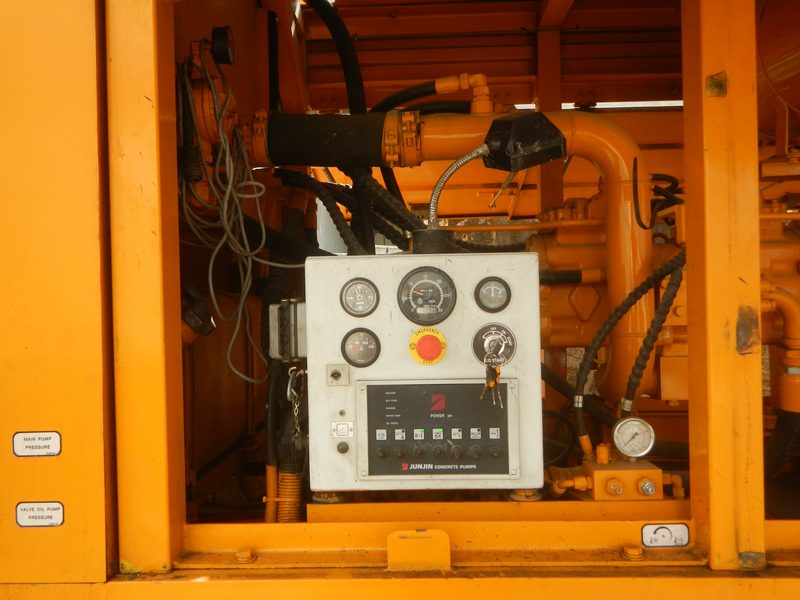
Diagnosis: measure pilot pressure at the valve block test points (Schwing labels these M1, M2, etc.). Compare readings against the DTR service manual specifications.
2. Main Hydraulic Pump Leakage
The piston-type hydraulic pump in Schwing machines (typically Rexroth, Sauer-Danfoss or Linde) develops internal bypass leakage after extended service hours or when oil cleanliness is not maintained.
Symptoms:
- Pump fails to reach nominal pressure with actuators in good condition
- Hydraulic oil overheats rapidly (energy that should drive the cylinders is dissipated as heat through internal bypass)
- Irregular, pulsating piston movement at low speeds
Diagnosis: perform a pump pressure test at the dedicated test port on the hydraulic pump outlet. Pressure below specification with the relief valve intact indicates internal pump wear or damaged pump pistons.
3. Hydraulic Oil Overheating
The Schwing BP 600 under sustained high-demand operation (maximum pressure, stiff mixes, continuous cycling) can experience oil temperature problems. The safe operating range for hydraulic oil is typically 60–70°C (maximum 80°C under extreme conditions).
Causes of overheating:
- Blocked oil cooler (fins clogged with dust or concrete dust)
- Defective thermostat (thermostatic valve opening too early or too late)
- Internal bypass in the hydraulic pump or motor (energy lost as heat)
- Low oil level (reduced thermal mass in the reservoir)
- Excessive operating pressure caused by a faulty relief valve set too high
Diagnosis: use an infrared thermometer on the oil cooler inlet and outlet hoses. A temperature difference below 5–8°C across the cooler under normal load indicates an ineffective cooler – clean or replace.
4. Uneven Cylinder Wear
Schwing – like all major brands – uses replaceable cylinder liners in the concrete cylinders. With highly abrasive mixes (granite aggregate, TR0 stiff mixes) wear progresses faster. Symptom: increasing piston-to-cylinder clearance, cement laitance in the water box, dropping output pressure.
Replace cylinders when bore wear exceeds manufacturer tolerance, always together with new pistons. Fitting new pistons into a worn cylinder will destroy them prematurely.
Schwing BP 600 vs BP 1400 – Application Guide
| Parameter | BP 600 | BP 1400 |
|---|---|---|
| Max. output | approx. 60–70 m³/h | approx. 100–140 m³/h |
| Max. concrete pressure | up to ~85 bar | up to ~130 bar |
| Typical application | 1–4 storey buildings, foundations, slabs | High-rise, bridges, long pipelines, SCC |
| Machine weight | approx. 2,800 kg | approx. 4,500 kg |
| Drive options | diesel or electric | diesel or electric |
The BP 600 is the daily workhorse for small and medium contractors. The BP 1400 is the project machine for main contractors on large contracts where pressure and volume requirements exceed what the BP 600 can deliver.
Mobile Schwing Service – PHS Magnum
PHS Magnum services Schwing trailer pumps and boom pumps both at the workshop in Chorula (near Opole, 4 km from motorway A4) and on-site throughout Poland within 200 km of Chorula. Service scope:
- Hydraulic system diagnostics (pressure testing, oil analysis)
- Repair and replacement of hydraulic valves, cylinders, main pumps
- Piston, cylinder, S-valve and spectacle plate replacement
- TDT safety inspections – mandatory for legal operation
- Mobile service to: Opole, Katowice, Wrocław, Kraków, Legnica, Częstochowa
ISO 9001:2015 certified. Available 7 days: +48 602 716 551 – response within 2 hours of enquiry.
Related: Pump service · S-valve and cylinder regeneration · TDT revision · Putzmeister vs Cifa