In brief
A pre-season inspection is an investment that pays for itself the first time a breakdown is avoided. Optimal timing: February–March or October–November. Key inspection points: pistons, S-valve, agitator shaft seals, DN hoses, hydraulic oil filter, lubrication, drum automation, and TDT expiry date. PHS Magnum offers a mobile inspection service within 200 km of Chorula, near Opole – tel. +48 602 716 551.
Why is a pre-season inspection critical?
A concrete pump operates under extreme conditions: abrasive concrete, high hydraulic pressures (up to 150 bar and beyond), heavy mechanical loads on the boom, and wide temperature swings. After the winter season or a cold-weather lay-up, many components require particularly close attention.
Service records consistently show the same pattern: the majority of serious concrete pump failures occur in the first weeks of the spring season – shortly after a machine that has stood unused through winter is recommissioned. Problems that could have been identified and fixed cheaply escalate into major faults in the middle of the busiest period of the construction calendar.
A pre-season service inspection is not a cost – it is an insurance policy. Aleksy Pasternak writes about the scope of a 500-hour concrete pump service inspection .
When to inspect – two optimal windows
Spring inspection (February–March)
The best time is 3–6 weeks before planned intensive work resumes. This allows time to:
- Order any required spare parts (pistons, DN hoses, seals)
- Carry out repairs identified during the inspection
- Avoid downtime at the height of the season
Post-season inspection (October–November)
An inspection after an intensive season (especially following the summer) allows you to:
- Detect piston wear before the cylinders are damaged
- Flush and clean the pumping system before frost
- Protect the hydraulic system for winter
- Carry out any repairs during the quieter period for the construction industry
15-point concrete pump inspection checklist
Pumping system
1. Condition of rubber pistons Check the clearance between piston and cylinder (limit: >0.5 mm for pumps up to 80 bar, >0.3 mm for above 120 bar). Cement slurry in the water box means the piston needs replacing.
2. Condition of concrete cylinders Visually inspect the inside of the cylinders after removing the pistons: longitudinal scoring, uneven wear, pitting. A cylinder in poor condition will quickly destroy new pistons.
3. S-valve (the heart of the pump) The S-valve passes through concrete on every stroke. Check: wear on the valve shaft, condition of the internal rubber seals, tightness in the closed position, and rotational axis play. A leaking S-valve causes an immediate drop in output and pressure.
4. Valve box seals (Brillenplatte, Schneidring) The spectacle plate and cutting ring (Schneidring) are the sliding elements of the S-valve. Replace if the clearance between the plate and ring exceeds the manufacturer’s tolerance.
Hydraulic system
5. Hydraulic oil filter Replace the filter element regardless of sensor readings – after a winter lay-up, oil may have accumulated condensation. Check oil cleanliness (send a sample for laboratory analysis if contamination is suspected).
6. Hydraulic oil level and condition Check the oil level and colour. A milky emulsion indicates water in the oil – the system requires immediate flushing and an oil change. Dark, burnt oil means the operating temperature has been too high.
7. High-pressure hydraulic hoses Inspect every hose: cracks in the outer layer, swelling, corrosion at fittings. Replace hydraulic hoses after 4–6 years or on any visible damage.
8. Hydraulic oil cooler Clean the cooler fins with compressed air. A blocked cooler leads to oil overheating, which destroys seals and hydraulic pumps.
Lubrication and sealing
9. Central lubrication system Check: grease reservoir (top up to maximum), lubrication lines (no crimps or twists), lubrication points (confirm grease is reaching them – press manually and check for extrusion).
10. Agitator shaft seals (swivel joint, S-valve bearing) The swivel joint is one of the most leak-prone points on the machine. Check for traces of grease or oil around the housing, and measure axial and radial play.
11. Boom pivot bearings (boom pump) Every boom joint: check for play, corrosion, and lubrication. A bearing with excessive play operates under impact loading, which accelerates deterioration.
Pipeline and outlet components
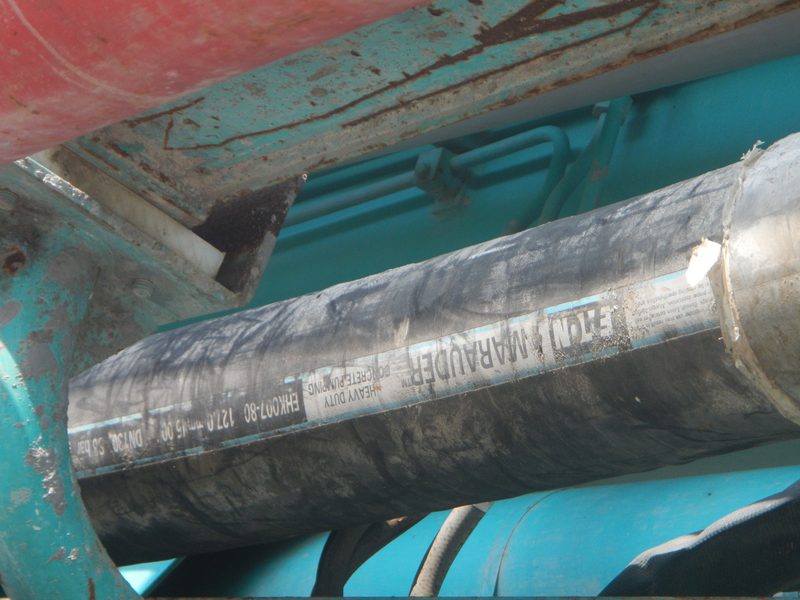
12. Distribution hoses DN 100/125 Check for external damage, deformation, and wall abrasion. On boom pumps, hoses flex with every boom movement – this is a critical wear point. Replace when wall thickness falls below the minimum specified in the manufacturer’s catalogue.
13. Pipeline couplings (clamps, quick-release couplings) Look for cracked retaining bolts, worn coupling seals, and flange corrosion. A loose coupling under pressure is a safety hazard.
Automation and safety
14. Mixer drum automation (mixer-pump units) Check the drum drive operation, condition of mixing blades, and water inlet seal. A cracked blade causes uneven mixing and concrete consistency problems.
15. TDT inspection validity date Check the machine documentation for the date of the last TDT inspection and when the next one is due. Operating a pump with an overdue TDT inspection is a regulatory violation and grounds for your insurer to refuse a claim. PHS Magnum arranges TDT inspections – ask when booking your service.
When is a service inspection required by regulation?
TDT regulations set mandatory inspection intervals for pumps with pressurised components (covering the hydraulic system and elements subject to concrete pressure above a defined threshold) and for boom pumps as machines with a hydraulic boom. Inspection intervals: external inspection every 2 years, and internal inspection together with the pressure test every 6 years. The specifics depend on the type of machine and the date of first commissioning.
A PHS Magnum service inspection does not replace a TDT inspection, but it is an essential complement that ensures the machine remains in full working order between statutory inspections.
How to book an inspection with PHS Magnum?
- Call +48 602 716 551 or email biuro@magnumchorula.pl
- Provide the pump make and model, year of manufacture, approximate operating hours, and a description of any symptoms you have noticed
- We will agree on a date: inspection at our workshop in Chorula, near Opole, or a mobile service visit to your location (within 200 km – covering the Opole, Katowice, Wrocław, and Kraków areas)
- After the inspection you receive a written report with a technical assessment and recommendations
We service: Putzmeister, Cifa, Schwing, Mecbo, Sermac. ISO 9001:2015 certified.
Related: Concrete pump service · TDT inspections · When to replace pistons · Magnum – specialist trailer service