In Brief
Concrete pump blockage — immediate response: stop pumping at once, try reverse (2–3 short bursts), then locate the plug by tapping the pipeline (a dull sound indicates the blocked section). Most common locations: 90° bends, pipe diameter changes, rubber delivery hose at the boom tip. Causes: concrete too dry (w/c < 0.45), break longer than 20 minutes without flushing, leaking S-valve. PHS Magnum mobile service reaches construction sites within 200 km of Chorula within four hours of call-out.
A pump blockage is not a mechanical failure in isolation — it is the result of a predictable sequence of avoidable errors. Once it has happened, here is exactly what to do.
How to Recognise a Blockage
The pump is blocked when:
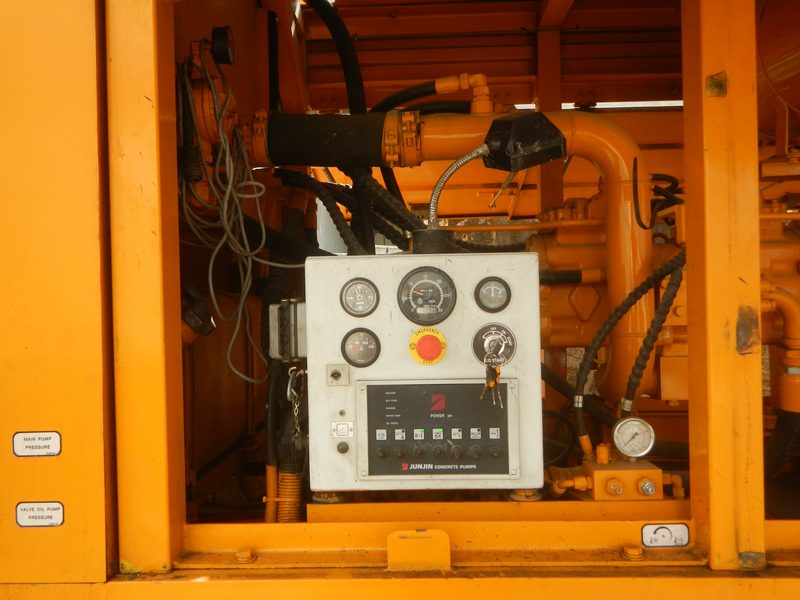
- Hydraulic system pressure rises sharply (the concrete pressure gauge or hydraulic motor indicator goes to maximum)
- The pump is running but no concrete is emerging at the boom tip or pipeline end
- The pump is running but you hear a characteristic rhythmic thudding with no flow
The first 30 seconds after the pump stops are critical — the concrete has not yet begun to set.
Clearance Procedure — Step by Step
Step 1: Stop Pumping Immediately
Do not attempt to “push through” the blockage by increasing speed. Shut the pump down. Every additional second of pumping increases pressure on the blocked section.
Step 2: Reverse
Most modern pumps (Putzmeister, Cifa, Schwing) have a reverse function — pumping concrete back into the hopper. Attempt 2–3 short reverse bursts. If pressure drops and concrete begins to flow back, the blockage was light and has cleared.
If reverse has no effect (pressure does not drop): the blockage is mechanical or the concrete has begun to set.
Step 3: Locate the Blockage
Walk the length of the pipeline and knock each section with your fist or a rubber mallet:
- Pipe with concrete flowing: dull, “wet” sound
- Blocked or empty pipe: metallic, hollow sound
Blockages most commonly occur at:
- Pipeline bends (90° and 45°) — particularly with stiff mixes
- The transition from horizontal to vertical sections
- Points where the pipe diameter changes
- Where the pipeline enters the rubber delivery hose (boom tip)
Step 4: Open the Coupling Upstream of the Blockage
At clamp couplings (Schnellkupplung): loosen the clamp just upstream of the blocked section. Take care — concrete may eject under residual pressure. Secure the area before opening.
Once open: push out the blocked section mechanically using a rod or rubber plunger — never a metal rod, which will score the pipe bore. Flush the rubber hose tip with water.
Step 5: Before Restarting
After clearing the blockage, before allowing concrete back in, flush the pipeline with water or neat cement grout (no aggregate). This checks the flow path and lubricates the pipe interior. Only then feed concrete from the mixer drum.
Most Common Causes of Blockage and How to Prevent Them
1. Concrete Too Dry (w/c Ratio Below 0.45)
Plastic concrete with a w/c of 0.50–0.55 pumps with virtually no problems. Dry, low-slump concrete (consistency class S1/TR0) is extremely abrasive and prone to plug formation.
Prevention: when ordering pumpable concrete, always inform the batching plant — concrete for pumping must have sufficient workability. For self-compacting concrete (SCC): verify that the flow spread is at least 600 mm.
2. Break Too Long Without Flushing
Time to initial set (time to loss of workability): 30–90 minutes at 20°C, 15–30 minutes at 30°C. Any site break longer than 20 minutes represents a risk.
Prevention: for any break longer than 15 minutes, pump the concrete back into the mixer drum or flush the pipeline with neat grout.
3. Pipeline Too Long or Too Complex
Each 90° bend is equivalent to approximately 5–8 m of straight pipeline in terms of flow resistance. A pump rated at 80 bar with 50 bends may not deliver sufficient pressure for a stiff mix.
Prevention: when planning the pipeline layout, minimise bend angles (use 45° + 45° rather than a single 90°) and verify that the pump has adequate pressure capacity for the intended configuration.
4. Worn S-Valve Seal
A worn or damaged S-valve seal (ring plate) allows air into the mix. Air entrained in the concrete creates gas plugs, particularly in vertical sections.
Prevention: check the S-valve for leaks at every 500-hour service interval.
When to Call a Service Engineer
Call out mobile service when:
- The blockage cannot be cleared within 30–45 minutes using the methods above
- Blockages recur on every load or every few loads (a systemic issue, not a one-off event)
- A pipeline coupling cracked or a hydraulic leak developed during clearance
- Reverse function does not work (electro-hydraulic fault, not a mechanical blockage)
Our mobile service engineers reach construction sites within 200 km of Chorula within four hours of call-out.
+48 602 716 551 — Call ahead, describing the pump make and symptoms — in many cases a preliminary diagnosis can be made over the phone.
Related: Concrete pump service · Concrete pump repair · TDT technical inspection