Summary
Boom pump: maximum mobility and arm reach up to 63 m – the right tool for multi-storey and commercial construction. Line/trailer pump: lower purchase cost, flexible pipeline routing – ideal for foundations, industrial floors and confined sites. Transit mixer pump: transport and pumping in one vehicle – optimal for scattered, small-volume jobs. Key selection criteria: reach, output, concrete mix, site access, and rent-vs-own economics. PHS Magnum services all three types from its workshop in Chorula, Poland, with mobile service up to 200 km.
The Three Concrete Pump Types – What Sets Them Apart?
Selecting the wrong pump for a project creates costs in two directions: either you overpay for capacity you don’t use, or you face downtime because the equipment can’t reach or handle what the job demands. Understanding the strengths and limits of each pump type is the first step to a sound decision.
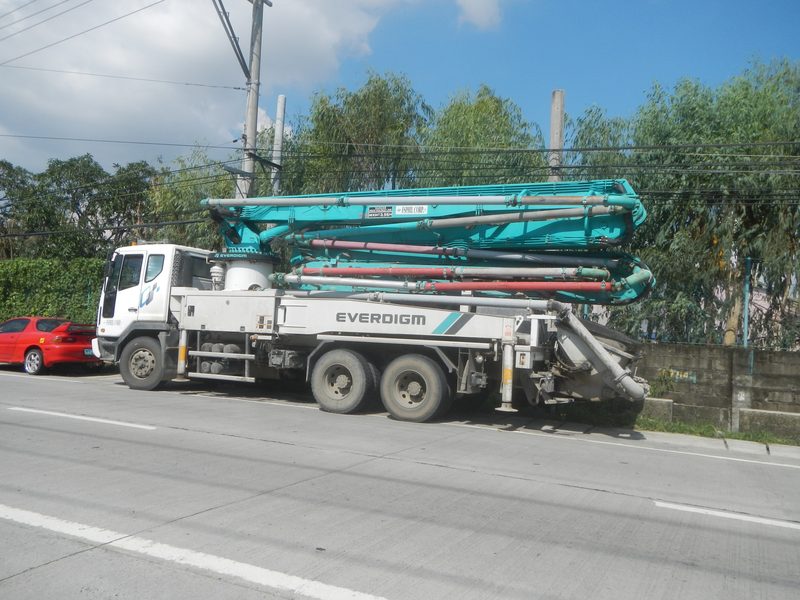
Boom Pump (Self-Propelled)
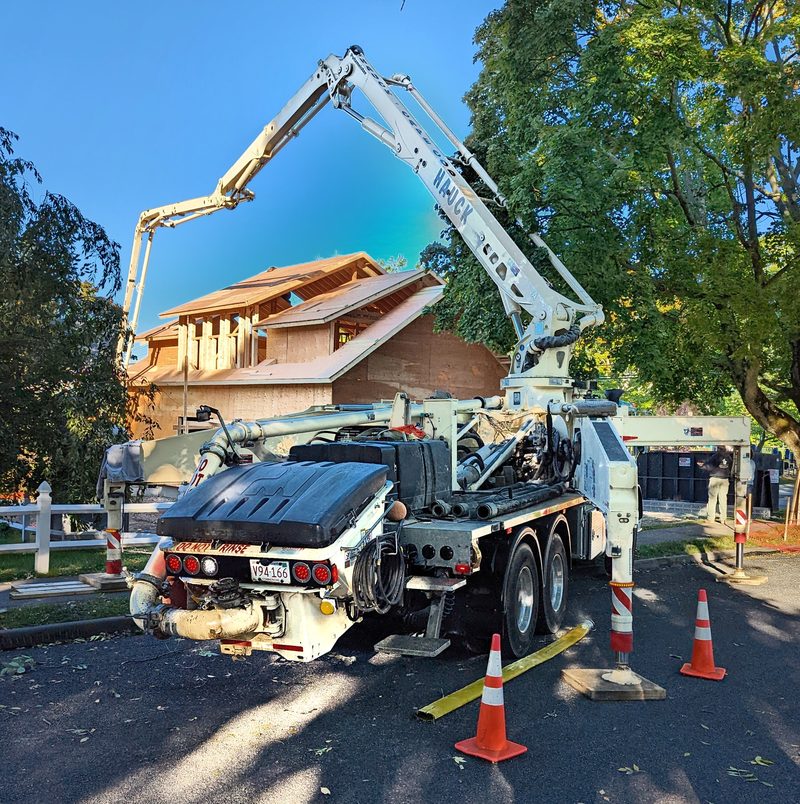
A boom pump is a truck-mounted unit with a multi-section hydraulically articulated placing arm. Concrete is fed from the mixer truck into the pump’s hopper, then driven by twin hydraulic cylinders through the pipeline built into the boom to the end hose.
Strengths:
- Horizontal and vertical reach from 24 m to 63 m and beyond
- Fast setup – ready to pump within 15–20 minutes of arrival
- Single operator manages the entire machine with remote control
- High output: 60–160 m³/h depending on model
Limitations:
- High purchase cost and depreciation
- Outrigger deployment requires firm, loadbearing ground
- Large footprint makes access to tight urban sites challenging
Best for: Multi-family residential (4–16 floors), office buildings, bridges, large industrial reinforced concrete structures.
Line Pump (Trailer Pump)
A line pump – also called a trailer pump or stationary pump – pushes concrete through a manually assembled run of steel pipe and rubber hose sections (typically DN 100 or DN 125). The pipeline can be routed through windows, along staircases, horizontally across floors or vertically up column forms.
Strengths:
- Significantly lower purchase price than a boom pump
- Concrete can be routed through narrow openings, confined spaces and custom geometries
- Light machine weight – no special ground bearing requirements
- Lower operating and service costs
Limitations:
- Pipeline assembly takes 20–60 minutes depending on run length and complexity
- Requires additional crew for assembly and stripping
- Horizontal reach limited by pipeline length and pump pressure (typically up to 300–500 m)
Best for: Single-family foundations, slab-on-grade pours, industrial floors, tunnel linings, buildings with restricted top access, large-area horizontal pours.
Transit Mixer Pump (Volumetric Pump)
A transit mixer pump combines a drum mixer and a concrete pump in a single vehicle. The concrete is either mixed on-site from dry components or carried in a ready-mixed drum and then pumped through a short boom arm or pipeline.
Strengths:
- Transport and pumping in one unit – no separate mixer truck required
- Ideal for scattered small jobs (foundation, driveway, small slab)
- Reduces waiting time for concrete delivery
- Cost-effective for small volumes: 2–15 m³ per job
Limitations:
- Limited pumping output (30–60 m³/h)
- Shorter boom reach compared to dedicated boom pumps (typically up to 12–16 m)
- More complex logistics as one vehicle serves two functions
Best for: Minor concrete works, detached house foundations, driveways and paved areas, geographically dispersed small jobs.
How to Choose the Right Pump: Five Key Criteria
1. Reach
Start with the placement geometry: how far must the concrete travel from where the pump can be positioned?
- Vertical reach above 15 m or horizontal reach beyond 50 m → boom pump or line pump with extended run
- Access from one side only, upper floors → boom pump with sufficient arm length
- Small areas, close-range placement → line pump or transit mixer pump
2. Required Output (m³/h)
Calculate your daily pour volume divided by available pumping hours. For a 200 m³ slab poured in 6 hours, you need at least 35 m³/h net at the point of placement. Add a 20–30% margin for interruptions and mix changes.
3. Concrete Mix Specification
Self-compacting concrete (SCC) and stiff mixes (TR0) are more abrasive and typically require pumps with higher operating pressure. Mixes with maximum aggregate size above 32 mm may not be compatible with smaller-diameter pipelines.
4. Site Access Conditions
Check: ground bearing capacity (critical for boom pump outriggers), site entrance width and headroom, clearance from building edges, possibility of stabiliser deployment.
5. Economics: Rent or Buy?
| Factor | Rental | Ownership |
|---|---|---|
| Working days/year | up to 15–20 | more than 20 |
| Unit cost | higher per day | amortises over time |
| Servicing | supplier’s responsibility | your responsibility |
| TDT/safety inspection | supplier’s responsibility | your own scheduling |
The break-even point depends on your local rental rates and utilisation forecast. As a rule of thumb: above 20 operating days per year on a consistent schedule, ownership starts to make financial sense.
What PHS Magnum Services
PHS Magnum in Chorula (near Opole, 4 km from the A4 motorway) specialises in the service and repair of all three concrete pump types. Brands covered: Putzmeister, Cifa, Schwing, Mecbo and Sermac.
Services include:
- Pumping unit service (pistons, S-valves, cylinders)
- Hydraulic system repair and diagnostics
- TDT safety inspections – mandatory for legal operation in Poland
- Spare parts: rubber pistons, S-valves, spectacle plates, DN hoses
- Mobile service within 200 km of Chorula – Opole, Katowice, Wrocław, Kraków
ISO 9001:2015 certified. For service or technical advice call +48 602 716 551 (response within 2 hours).
Related: Concrete pump types · Pump service · Pressure vessel TDT inspection · Silo trailer spare parts